🔌 LED Drivers: An Essential Role in Professional Lighting
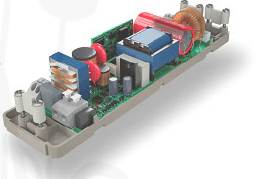
LED drivers, also known as LED power supplies, provide electrical power to LED luminaires. Their role is crucial: they regulate voltage and current so that LEDs do not flicker and remain efficient. Indeed, the number of LEDs in a lamp varies by model, requiring adapted control.
⚙️ How LED Drivers Work
LED drivers use voltage chopping and pulse width modulation (PWM) techniques.
-
Step-down voltage devices provide the necessary power to series-connected LEDs.
-
A current-sensing inductor stabilizes the input voltage and achieves the expected light output.
Thus, drivers ensure the conversion of alternating current to direct current, regulate the current flowing through the LEDs, and protect against electrical fluctuations (for example, caused by faulty fluorescent lamp ballasts).
🔄 Different Types of LED Drivers
There are two main categories:
-
Constant voltage drivers,
-
Constant current drivers.
Furthermore, some models integrate advanced functions:
-
Luminous flux dimming from 100% to 5-10%.
-
Control via CCR (constant current reduction), PWM (pulse width modulation), or digital protocols like DALI.
Most dimming drivers operate with the PWM method. Consequently, the light appears continuous and flicker-free, even at frequencies of several hundred Hz to kHz.
🔒 Reliability and Durability of LED Drivers
The sensitive electronics of the driver are directly exposed to environmental effects. Therefore, it is crucial to consider all factors influencing its reliability.
Technological and Environmental Requirements
-
High efficiency → essential for energy savings.
-
Dimming function → reduces consumption during inactivity.
-
Electrical characteristics → PFC, THD, Ripple.
-
High reliability → reduces maintenance costs.
-
Long lifespan → compatible with LEDs designed to last > 50,000 hours in harsh environments.
📏 Performance Measurement
The LED driver determines the overall performance of the luminaire. However, the wide variety of models makes the choice complex.
Indeed, two seemingly similar products can react differently depending on the operating conditions. Thus, to ask manufacturers the right questions, it is necessary to understand the risks and clearly specify technical needs.
⚡ Energy Efficiency and Thermal Management
The main advantage of a high-efficiency LED driver is energy savings.
-
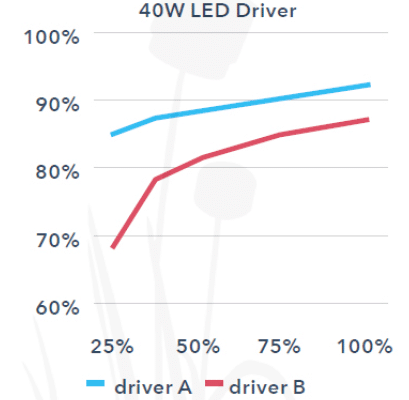
At 90% efficiency, the dissipated power is almost half that of an 80% efficient driver.
-
Consequently, over a lifespan of 50,000 hours, the savings become significant.
Furthermore, better efficiency reduces the heat generated by the driver. Thus, the operating temperature is lower, which increases the lifespan of components (capacitors, circuits).
👉 According to Arrhenius’ rule, a 10 °C increase reduces the lifespan of electrolytic capacitors by 50%.
Therefore, the lower the temperature, the more reliable the driver.
Finally, during dimming, efficiency can vary depending on the model and manufacturer. It is therefore essential to check the driver’s efficiency at different load levels before making a choice.
🔆 Dimming (LED Dimming)
Why Dimming is Essential
Dimming is now indispensable for reducing lighting costs. Indeed, adjusting brightness allows for energy savings when full power is not needed.
However, an inadequate selection of the LED driver can reduce energy efficiency.
-
PWM (pulse width modulation) and linear dimming methods can sometimes cause flicker, especially at very low brightness levels.
-
Thus, it is crucial to check driver compatibility when choosing the luminaire.
⚡ Ripple Current
A Phenomenon to Monitor
The AC/DC conversion of an LED power supply always generates an output ripple.
-
This ripple adds an alternating component to the direct current.
-
As a result, an alternating current flows through the LEDs, which can cause visual discomfort (flickering LEDs).
Consequences for Lifespan
In particular, during low-level dimming, the ripple becomes more visible.
-
At a frequency less than or equal to 100 Hz, flicker is perceptible to the human eye.
-
Consequently, it is essential to minimize ripple and flicker.
-
If the ripple current exceeds the absolute limit of the LED’s direct current, the lifespan of the LED chips can be significantly reduced.
🔋 Standby Consumption and Startup Time
European Standards
According to European Union directives, a lighting device must consume:
-
less than 1 W in standby,
-
and now less than 0.5 W with a startup time of less than 0.5 seconds for certain types of lighting.
Thus, choosing a high-performance LED driver allows these requirements to be met while improving the user experience.
🔌 Power Factor (PF)
Its Importance
The power factor (PF) is the ratio between the real power used by the load and the apparent power in the circuit.
-
A low power factor leads to higher current consumption for the same useful power.
-
Furthermore, higher currents generate energy losses and require larger cables and more expensive equipment.
European Regulations
Below 2 W, no requirements are imposed.
Above this, the power factor must be regulated:
-
2W < P ≤ 5W → PF > 0.4
-
5W < P ≤ 25W → PF > 0.5
-
P > 25W → PF > 0.9
Key Takeaways for Designers
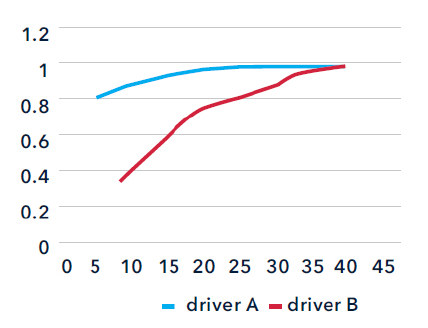
However, the power factor varies with the load level.
-
At reduced load, the PF is lower than the nominal power.
-
Therefore, designers must anticipate this behavior to ensure compliance with EU Directives, even for dimmable drivers.
🎛️ Total Harmonic Distortion (THD) in LED Drivers
What is THD?
Total Harmonic Distortion (THD) is an essential characteristic of LED drivers. It measures the quality of the current consumed by the luminaire and its impact on the electrical grid.
Operation and Origin of the Problem
A typical switching power supply, such as an LED driver, converts AC mains to DC voltage using a rectifier bridge or similar circuit.
-
The output voltage is then derived from this DC bus.
-
However, the rectifier is a non-linear device, which causes degradation of the input current.
-
Thus, the current is subject to harmonic distortions, related to the voltage frequency.
Consequences in Electrical Systems
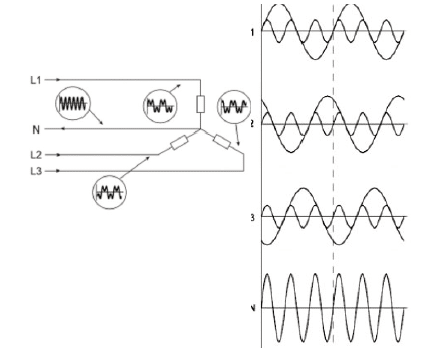
In an asymmetrical three-phase system, the 3rd harmonics of the voltage can generate a significant current in the neutral cable.
-
Consequently, this cable, often of smaller cross-section, can dangerously overheat.
-
Excessive harmonic distortion therefore poses a serious risk to electrical safety and the reliability of installations.
Limit THD for More Safety
As a safety measure, THD must be kept below 20%.
-
Thus, the risks of overheating and grid degradation are limited.
-
Furthermore, low THD improves overall energy efficiency and extends the lifespan of LED components.
🔒 LED Driver Reliability: Lifespan vs. MTBF
Definition of Reliability
By definition, reliability is the probability that a product will correctly perform its function under given conditions for a defined period.
-
Indeed, reliability depends on operating conditions, usage time, and product design.
-
For LED drivers, critical criteria include:
-
high efficiency to ensure energy savings,
-
sufficient reliability to limit maintenance costs,
-
long lifespan compatible with that of LED chips,
-
and dimming to extend usage time while reducing consumption.
-
MTBF: A Statistical Measure of Reliability
Reliability is often expressed by the MTBF (Mean Time Between Failures).
-
In theory, a high MTBF means better reliability.
-
However, there is no direct proportionality between MTBF and the actual lifespan of a product.
MTBF Formula
MTBF = (n × t) / R
-
n: number of units
-
t: operating time
-
R: number of observed failures
👉 Concrete example:
If 1,000 units operate for 1,000 hours with 5 failures, the MTBF is 200,000 hours.
-
In other words, this does not mean that a single unit will last 23 years.
-
It means that, on average, a failure can be expected:
-
every 5 days if products operate 24/7,
-
or approximately every 15 days if usage is limited to 8 hours/day.
-
Reliability and Expected Lifespan
The lifespan indicates how long a product should operate under normal conditions (e.g., 50,000 hours).
Reliability can then be calculated by the formula:
R(t) = e^(-t/MTBF)
👉 Thus, the probability that a device exceeds its MTBF is approximately 36.8% (R=0.3677).
Example of Reliability Calculation (50,000 h Expected Service)
| Expected Service Time (h) | MTBF (h) | Reliability (%) |
|---|---|---|
| 50,000 | 100,000 | 60.65% |
| 50,000 | 250,000 | 81.87% |
| 50,000 | 400,000 | 88.25% |
| 50,000 | 500,000 | 90% |
👉 Conclusion: even a 400% increase in MTBF only leads to a 30% improvement in reliability for the same lifespan.
The Bathtub Curve of Reliability
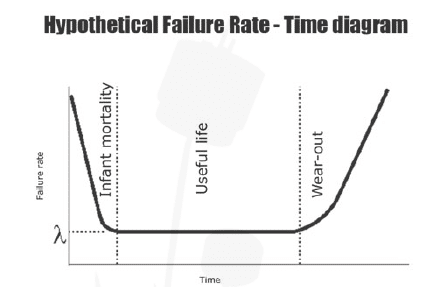
The lifespan of a population of LED drivers is divided into three distinct phases, represented by the famous “bathtub curve”:
-
Infant mortality → early failures due to initial defects.
-
Useful life → period of stable operation with a low failure rate.
-
Wear-out → end of life with a progressive increase in failures.
📉 LED Driver Reliability and Life Phases
Early Failures
At the beginning of the service period, production defects can cause a high failure rate.
-
However, this number of failures decreases significantly thereafter.
-
Indeed, robust design, stress testing, and rigorous quality assurance greatly reduce these early failures.
Useful Life Period
During the useful life phase, failures occur randomly.
-
However, the failure rate remains almost constant.
-
This period extends from the product’s commissioning to the beginning of the wear-out phase.
-
Thus, it is directly determined by the expected lifespan of the electronic components used in the assembly.
Wear-out Phase
Over time, components gradually degrade.
-
Consequently, failures appear at an increasing rate, mainly due to wear related to aging, electrical, and thermal stresses.
-
In this phase, the calculated MTBF no longer applies.
-
For example, a device with an MTBF of 10 years can wear out in just 3 years.
👉 In summary, MTBF is valid only during the product’s normal lifespan. Wear-out remains unpredictable, even for high-quality components.
Manufacturers’ Objective
Generally, serious component and power supply manufacturers aim to offer a useful life greater than the design life, to ensure reliable performance over the long term.
🌡️ Reliability Measures: Operating Temperature
Impact of Temperature
The operating temperature strongly influences the lifespan of an LED driver.
-
Therefore, thermal management is a key criterion in luminaire design.
-
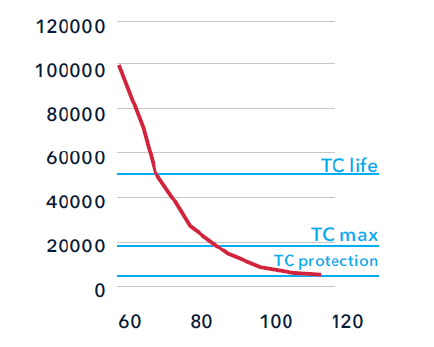
Typically, the maximum case temperature (Tcmax) is used as a reference to define the guaranteed lifespan of an LED driver.
Limits and Protections
Even if some models have integrated thermal protection, it is often triggered well beyond the Tcmax limit.
-
Consequently, the expected lifespan of the driver significantly decreases if no external protection is installed.
-
Thus, it is recommended that the luminaire designer adds an external thermal protection system, ensuring better long-term reliability.
🔋 Electrolytic Capacitors and Critical LED Driver Components
The Weak Link in a Driver’s Lifespan
The reliability of an LED driver is determined by its weakest component.
-
Indeed, in AC/DC power supplies, it is generally the aluminum electrolytic capacitors that have the shortest lifespan.
-
Therefore, the overall lifespan of an LED driver often depends on these capacitors.
👉 To ensure better longevity, it is recommended to use long-life capacitors.
Impact of Temperature on Lifespan
Arrhenius‘ rule states that the lifespan of aluminum capacitors doubles for every 10 °C decrease in operating temperature.
-
Thus, it is essential to maintain electrolytic capacitors at a minimum temperature to extend their lifespan.
-
However, the overall failure rate of LED drivers is largely influenced by the case operating temperature.
👉 As a general rule, the failure rate increases by 25 to 40% for every 10 °C increase in temperature.
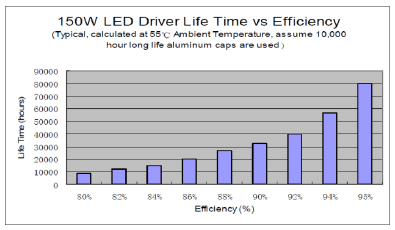
⚡ LED Driver Efficiency and Impact on Lifespan
A Determining Factor
As mentioned previously, the efficiency of an LED driver plays a major role in its longevity.
-
Indeed, the higher the efficiency, the fewer thermal losses.
-
Thus, the self-heating phenomenon is reduced, and internal components experience less thermal stress.
Concrete Example of Improvement
Let’s take the case of a 150 W LED driver:
-
At 85% efficiency, its lifespan is limited by internal heat losses.
-
In contrast, if efficiency increases to 93%, the driver’s lifespan is multiplied by 2.5.
Direct Consequences
-
Consequently, higher efficiency not only translates into energy savings but also into a significant increase in reliability.
-
Furthermore, the reduction in thermal stress improves the performance of capacitors, MOSFETs, and other critical components, delaying premature wear-out.
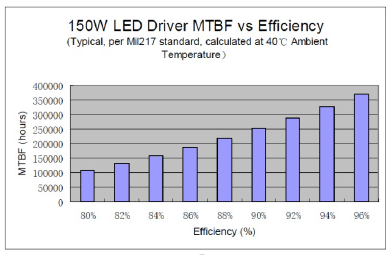
The calculated MTBF of a 150 W driver increases by approximately 90% as the driver’s efficiency goes from 85% to 94%.
🔧 Reliability of Solder Joints
Risks Related to Thermal Cycling
The reliability of solder joints can be compromised by temperature variations.
-
Indeed, the differential thermal expansion of soldered materials leads to mechanical stresses.
-
Thus, cracks can appear in the solder joint over time.
Other Sources of Stress
In addition to thermal expansion, mechanical factors such as the use of heavy components or exposure to repeated vibrations can also weaken solder joints.
Best Practices for Maximizing Reliability
To limit these risks and ensure the robustness of LED drivers, it is recommended to:
-
select high-quality components, especially critical semiconductors,
-
reduce the operating temperature by optimizing efficiency,
-
provide sufficient design margins for all components,
-
apply strict design procedures.
💰 Financial Considerations and Cost Optimization
The Importance of the Economic Dimension
In addition to technical performance, financial expectations play a central role in choosing an LED driver.
-
Consequently, manufacturers must integrate features that reduce not only operating costs but also installation costs.
Reducing Installation Costs
A concrete example is the ability to connect multiple LED drivers to the same circuit breaker.
-
Indeed, the number of connected drivers is limited by the circuit breaker’s trip current.
-
However, if all drivers have optimized inrush current, several units can be connected simultaneously without issues during startup.
-
Thus, the installer reduces the number of necessary circuits, which generates immediate savings on the electrical infrastructure.
⚡ Inrush Current in LED Systems
A Phenomenon Not to Be Overlooked
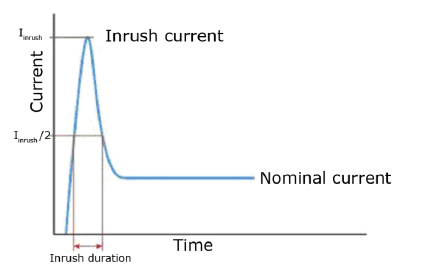
When starting an LED lighting system, a very high initial transient current can occur.
-
Indeed, this current can be several times higher than the nominal current during normal operation.
-
However, even if it generally lasts less than 10 milliseconds, it can be enough to trip a circuit breaker.
Origin of Inrush Current
This phenomenon is mainly caused by:
-
the rapid charging of capacitors in LED driver power supplies,
-
or the fact that the transformer’s magnetic flux has not yet stabilized.
Thus, inrush current is one of the electrical constraints to anticipate in any LED lighting project.
An Effective Solution: Drivers with Inrush Current Regulation
Selecting LED drivers equipped with inrush current regulation is a simple and cost-effective solution.
-
Consequently, these drivers reduce the risk of nuisance tripping of circuit breakers.
-
Furthermore, they are particularly suitable for modernization projects, as they simplify wiring while enhancing installation reliability.
🔎 How to Select the Best LED Driver?
Essential Criteria
To choose the best driver for an LED luminaire, several factors must be considered:
-
lifespan,
-
reliability,
-
energy performance,
-
and financial considerations.
Indeed, it is often difficult to compare specifications between manufacturers. Therefore, it is not recommended to base the decision solely on purchase price, as this overlooks crucial criteria for real-world performance.
Market-Leading Manufacturers
Recognized brands such as MeanWell, Philips, Inventronics, Osram, Turful, Tuv, Sosen, or Moso offer a wide range of LED drivers for indoor and outdoor applications.
Thus, their products are distinguished by:
-
efficiency up to 95%,
-
a power factor up to 0.99,
-
robust lightning protection,
-
IP67 waterproofing,
-
and full compliance with international standards (safety, electromagnetic compatibility, overvoltage, overcurrent, and overheating protection).
👉 These drivers are widely used for demanding solutions: LED streetlights, tunnel lighting, workshops, industrial premises, storage areas, parking lots, recreational areas, sports fields, and stadiums.
NOVETI Expertise
The NOVETI range (SFL, HFL, and XFL series) goes even further to ensure durability:
-
use of long-life electrolytic capacitors, certified for 50,000 hours between -40 °C and +85 °C,
-
low-ripple current regulation, offering stable, flicker-free light,
-
smooth dimming thanks to 1-10V dimmable options,
-
self-regulating thermal design, allowing a warranty of up to 5 years.
Consequently, NOVETI drivers ensure superior reliability, even in extreme conditions.
The Central Role of the LED Driver
The LED driver accounts for nearly 80% of an LED luminaire’s reliability.
-
Below a certain quality level, it is no longer possible to guarantee a luminaire luminous uniformity, optimal efficiency, and lasting reliability.
-
Therefore, choosing a high-quality LED driver, such as those from NOVETI, is essential to maximize the overall performance of your lighting installations.
📚 Useful Resources on Professional LED Lighting
👉 Also discover our other solutions and practical guides:
-
LED Lighting for Padel Courts – Standards and technical solutions for outdoor padel courts.
-
LED Lighting for Outdoor Tennis Courts – Advice, challenges, and high-performance solutions for clubs and communities.
-
Stadium M22 LED Floodlights – High-power floodlight ideal for relamping football fields and sports infrastructures.
-
LED Construction Site Strips – Robust and waterproof solutions for construction sites, hazardous areas, and demanding environments.
-
Industrial Lighting Solutions – LED luminaires for warehouses, workshops, and logistics areas.
-
Dialux Photometric Studies – Custom design and optimization of lighting performance.
-
-
Philips – LED Driver Lifetime and Reliability (White Paper)
👉 Read Philips’ LED Driver Reliability Guide
A technical reference document explaining how thermal management and component selection influence the lifespan of LED drivers.
-
ANSI/NEMA – Standard C82.15-2021 on LED Driver Robustness
👉 Consult NEMA ANSI C82.15-2021 Standard
An official standard that defines robustness criteria and test methods for LED drivers (overvoltage, temperature, lifespan).
-