When choosing a professional LED floodlight, IP and IK ratings regularly appear among the technical specifications announced by manufacturers.
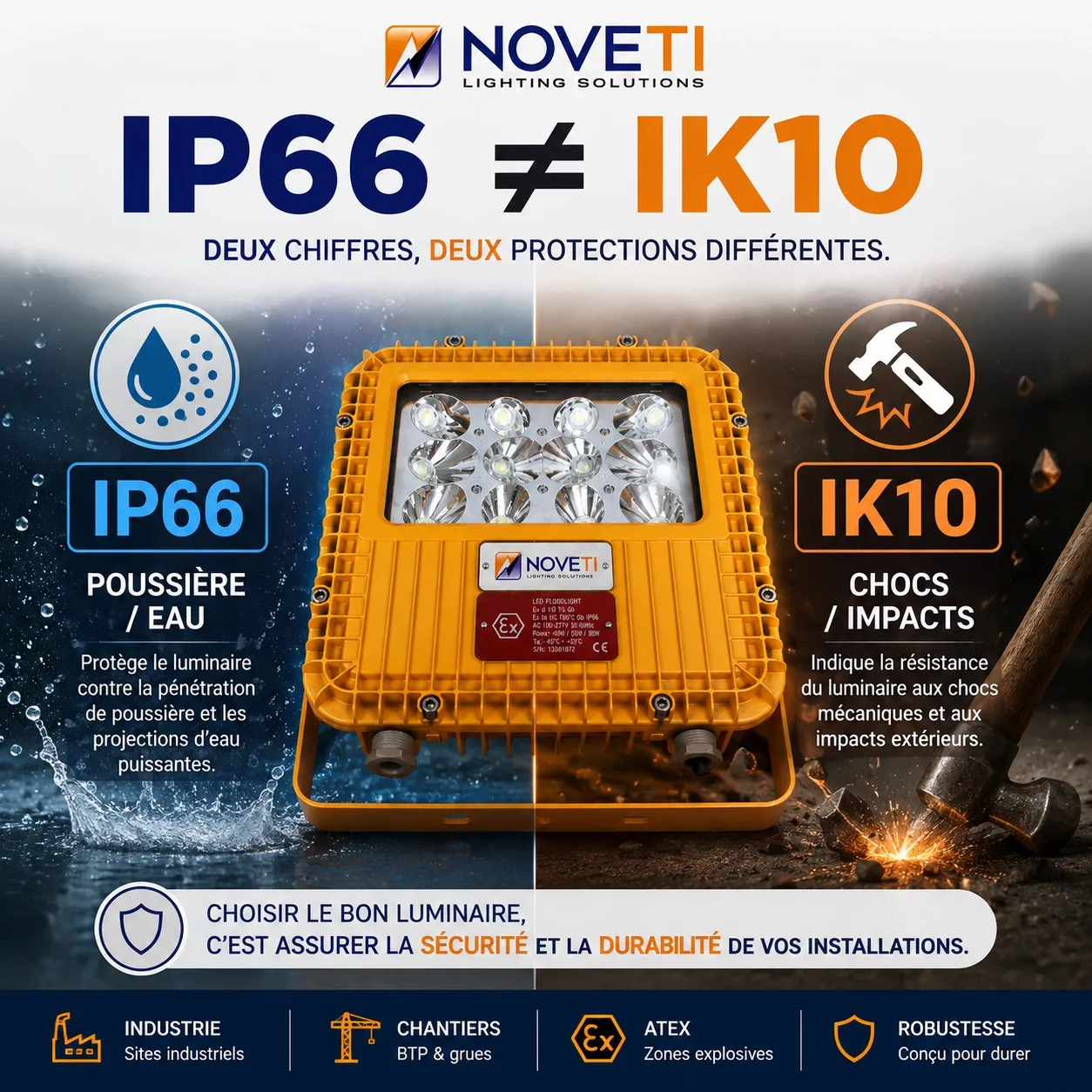
Yet these two ratings correspond to very different types of protection.
A floodlight can be protected against dust and powerful water jets without offering high resistance to mechanical impacts.
IP66: protection against water and dust
The IP rating (Ingress Protection), defined by the IEC 60529 standard, describes the level of protection provided by an equipment enclosure against the ingress of solid objects and liquids.
For an IP66 floodlight:
- The first digit 6 indicates complete protection against dust ingress.
- The second digit 6 indicates protection against powerful water jets from any direction, under the test conditions set out in the standard.
This protection is particularly useful for lighting installed outdoors, on construction sites, cranes, in quarries or in some industrial environments.
Be careful, though: IP66 does not mean the floodlight can be immersed in water.
IK10: resistance to mechanical impacts
The IK rating, defined by the IEC 62262 standard, describes the resistance of an equipment enclosure to external mechanical impacts.
An IK10 rating corresponds to an impact energy of 20 joules, roughly the energy of a 5 kg mass falling from a height of 40 cm.
This resistance is particularly useful in environments where equipment is exposed to accidental knocks and repeated handling.
However, IK10 does not mean the floodlight is indestructible.
Two different and complementary types of protection
An IP66 floodlight is not necessarily IK10.
Conversely, an IK10 floodlight does not necessarily offer high protection against water and dust.
In short:
- IP: protection against the ingress of water and dust.
- IK: resistance to external mechanical impacts.
Choosing a floodlight suited to its environment
On a crane, in a quarry, a tunnel, an industrial workshop or on a civil engineering site, the constraints are not always the same.
Beyond lighting performance, several criteria must be taken into account:
- Exposure to water and dust.
- The risk of mechanical impacts.
- Vibrations.
- Operating temperatures.
- Thermal design.
- Ease of maintenance and repair.
IP and IK ratings do not cover all of these constraints, but they are important criteria when choosing professional lighting.
Technical specifications that must be backed up
Beyond the ratings shown on a datasheet, it is worth asking the supplier for the test reports that support the claimed levels of protection.
A protection rating is not simply a sales argument. It corresponds to test conditions defined by standards.
Choosing the right professional lighting starts with understanding the constraints it will actually face.